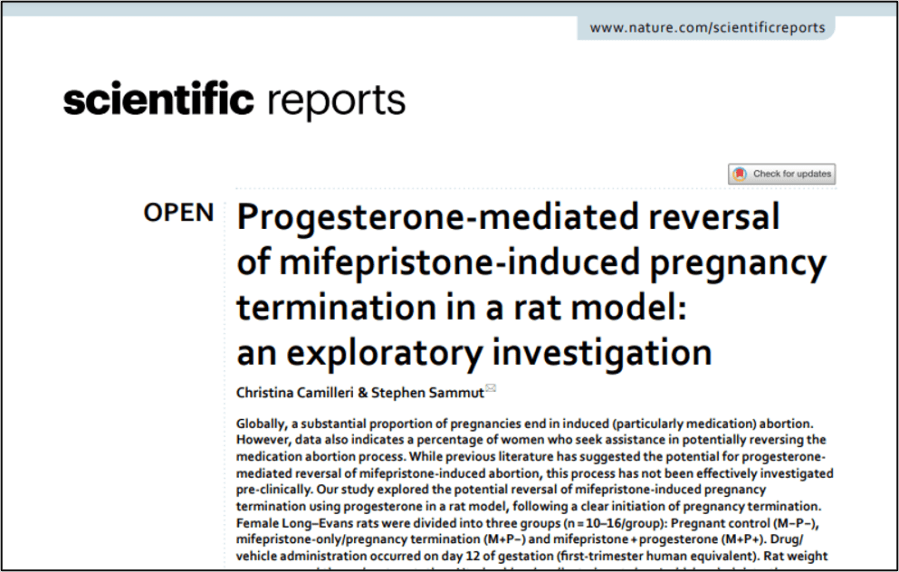
Camilleri C and Sammut S
Published in Scientific Reports, 6 July 2023
doi: 10.1038/s41598-023-38025-9
Click here to download the full-text of the research study.
Click here to download a pdf version of the summary. A brief version is available here.
Highlights
- Mifepristone (and no progesterone) causes a complete pregnancy termination.
- Progesterone reverses the effects of mifepristone (i.e., reverses the abortion).
- Living offspring were present at the end of gestation in a majority of rats in the reversal group.
- Fetal heart rates in the reversal group were comparable to those of the normal pregnancy group.
- At the end of gestation, the successful reversal group was comparable to the normal pregnancy group and not the abortion group.
- In conclusion, this study confirms the potential for progesterone to reverse an abortion during the early stages of the abortion process.
Background:
A substantial proportion of pregnancies end in induced abortion globally. Increasingly, medication abortions have become more prevalent over time. Data also indicates a percentage of women who seek assistance in potentially reversing the medication abortion process.
Progesterone is the major hormone that is necessary to maintain a pregnancy. In medication abortion, the first drug administered (mifepristone, RU-486) works by blocking the progesterone receptor, thus terminating the pregnancy. While previous literature and clinical reports have suggested the potential use of progesterone to reverse a mifepristone-induced abortion, the process has not been effectively investigated pre-clinically.
Goal of the Study:
This study explored the potential reversal of a mifepristone-induced pregnancy termination using progesterone in a rat model* at a gestational time that is equivalent to first trimester (the time when many medication abortions occur) in humans.
* While there are clear differences between animals and humans, there are many similarities, at many levels. This allows scientists to utilize animal models to investigate various questions keeping the limitations of the differences in mind.
Results:
The results of our study indicate that in a pregnant rat (at first-trimester human equivalent):
- Mifepristone (and no progesterone) causes a complete pregnancy termination.
- The administration of progesterone following mifepristone reverses the effects of mifepristone, resulting in living offspring at the end of gestation in a majority of rats (81.3%).
In short, the following observations were made (refer to Figure 2 in text for a graphical representation of the weight observations described below):
- The abortion group and reversal group: Initiation of abortion observed (evident in weight loss and uterine bleeding).
- The abortion group: Pregnancy terminated 100% of the time (evident in continued weight loss and absence of fetuses).
- The reversal group: Termination initiated (evident in weight loss and uterine bleeding), but then reversed (evident by resumption of weight gain at a comparable rate to those carrying a normal pregnancy and the presence of fetuses).
- The unsuccessful reversal group: Similar to the abortion group.
- Fetal heart rates in the reversal group were no different from those in the normal pregnancy group.
Conclusion:
- This study addresses the successful reversal of an initiated mifepristone-induced abortion using progesterone in a rat model.
- The findings appear to support the clinical use of progesterone for the reversal of mifepristone-induced abortion.
- The findings of the study also indicate the necessity for additional research in order to ensure the best clinical practices and patient care.
 Sammut Lab