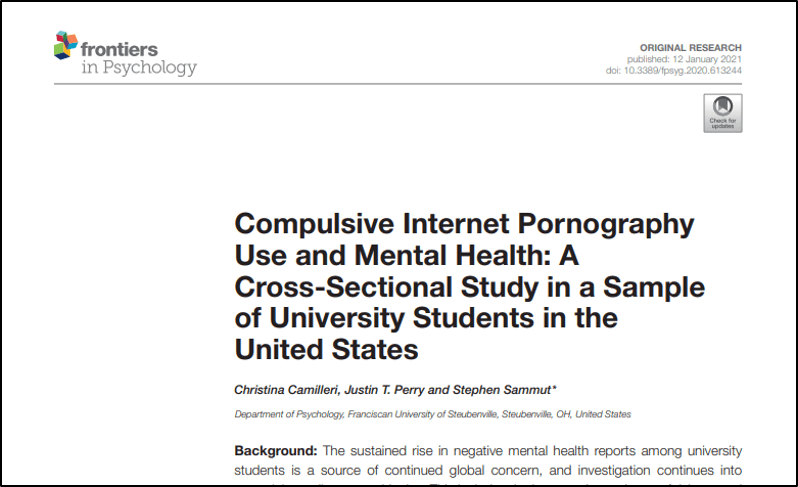
Camilleri C, Perry JT, and Sammut S
Published in Frontiers in Psychology, 12 January 2021
doi: 10.3389/fpsyg.2020.613244
Click here to download the full-text of the research study.
Click here to download a pdf version of the summary below.
Highlights
- A majority of students reported consuming pornography at some point in their life.
- Males use pornography more than females.
- The internet and internet-related technologies are the most common ways of accessing pornography.
- First exposure to pornography primarily took place between the ages of 9-13, followed by 14-17.
- Age of first exposure was an important predictor of negative mental health.
- Pornography-use behaviors were similar to those seen in behavioral and substance addictions.
- Pornography use was related to worse mental health compared to those who never viewed pornography.
- In conclusion, this study confirms the negative impact of pornography on mental health, the behavioral similarities to addictive behaviors, and the positive role of faith, morals and personal motivation in reducing use.
Background:
- Mental health issues are a growing source of global concern and university students are one of the most vulnerable populations.
- Research efforts continue to investigate various factors that may potentially contribute to the negative mental health issues observed in university students including, but not limited to, childhood adversity, addictive behaviors, academic performance, post-graduation plans and risky sexual behaviors (e.g., number of sexual partners, sexting, etc.).
- The prevalence of pornography use among this population has increased.
- While extensively debated, the potential for addiction to pornography (behavioral addiction) with potential long-term consequences cannot be dismissed.
Please note: the volume of pornography use and negative mental health reported in this study fits within the findings of other research. Additionally, the neurological evidence from other students pertaining to pornography use supports our findings. Therefore, while the study was conducted within a Catholic university, the findings are of significance and relevance beyond the specific population investigated.
Goals of the Study:
Given the high prevalence of pornography use among university students and the potential for it to affect mental health, this study explored potential links between pornography use, compulsive use of pornography, and mental health, in a sample of university students (18 years of age and older).
Results:
Pornography Use
First Exposure
Compulsive (Addiction-like) Behavior
Mental Health Trends
Pornography & Mental Health
What Helped Reduce Use
- 56.6% of students reported pornography consumption at some point in their life.
- Use was higher among males (87.6%) than females (40.9%).
- The majority of participants (71.1%) indicated that they most often viewed pornography at the end of their day.
- 98.2% of participants reported Internet-related technologies (Cell phone, laptop and desktop computers, and tablets) as the primary mode of access of pornography.
- The majority of participants reported being exposed to pornography:
- Before the age of 18
- Between the ages of 9-13 years, followed by 14-17 years of age
- Through personal curiosity or unintentional exposure
- Age of first exposure was a predictor of negative mental health
- The majority of participants reported various behaviors observed in behavioral and substance addictions:
- Neglect of work/obligations/friendships to spend time accessing pornography (preoccupation)
- Unsuccessfully trying to spend less time or having difficulty to stop accessing pornography websites; continuing to access the websites despite a desire to stop (dependence)
- Accessing the websites when feeling down or as an escape/to get relief from negative feelings (emotional coping)
- Based on previous scientific literature and criteria: 57.0% of the participants displayed problematic (16.6%) and addictive (40.4%) pornography use.
- Data continues to indicate a progression towards more negative mental health across years.
- Pornography use was related to significantly worse mental health scores compared to those who never viewed pornography.
- A majority of those consuming pornography and desiring to decrease their use of it report faith life, moral principles and personal motivation as being major aids in achieving such a goal (in contrast to internet resources and other factors).
Conclusion:
- There is a clear relationship between pornography use and negative mental health.
- The behaviors observed in relation to pornography use bear similarities to aspects of behavioral addictions.
 Sammut Lab