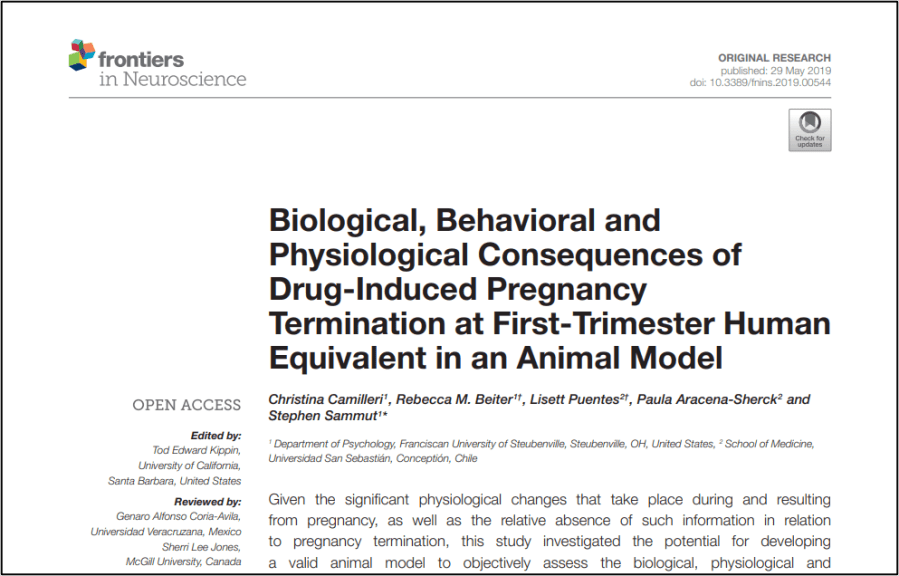
Camilleri C, Beiter RM, Puentes L, Aracena-Sherck P and Sammut S
Published in Frontiers in Neuroscience, 29 May 2019
doi: 10.3389/fnins.2019.00544
Click here to download the full-text of the research study.
Click here to download a pdf version of the executive summary. A brief version is available here.
Highlights
Pregnancy termination using mifepristone (RU-486) and misoprostol led to:
– A reduction in overall well-being (decrease in body weight and food consumption)
– Depression-like behavior
– Anxiety-like behavior
– Physiological changes to the oxidative stress system
– A removal of the benefits on fertility associated with pregnancy and giving birth.
- The changes observed were relatively long-term and reflected moderate to severe stress.
- The behavioral effects seen following chemical abortion were NOT observed in rats that miscarried naturally.
- The changes observed were clearly associated with the drug administration leading to abortion and not simply drug-administration.
Background:
Approximately 20% of all pregnancies in the U.S. end in abortion. The health implications of abortion on women continue to be a source of heated debate. Various health concerns have been reported, short- and long-term. These include both physiological (e.g. increased risk of cancer) and psychological effects (e.g. increased risk of mood disorders (including depression), anxiety, substance abuse, and suicide) on women who have undergone an abortion.
Given the seriousness of the potential mental health and physical consequences, and the difficulty of treating them if they occur, it is necessary to appropriately investigate these potential links to the abortion procedure. Unlike many other situations in medicine, there has not been any objective pre-clinical investigation of the potential serious physiological consequences of the termination of a viable pregnancy. Given the complex changes in the body associated with pregnancy, it is difficult to expect that terminating a viable pregnancy is without consequences.
Goal and Experimental Design:
While there are clear differences between animals and humans, there are many similarities in the physiology, neurology, neurophysiology and the resulting behaviors (e.g. in stress). Animal models provide the scientist with a comparative approach to address various questions (e.g. depression, schizophrenia, etc.), at various levels (e.g. behavioral, neurophysiological, molecular, etc.), in a significantly more controlled environment, independently of potential social, moral and other influences.
The goal of our study was to provide a pre-clinical investigation of the potential biological, physiological, and behavioral consequences of induced abortion in an animal model (a laboratory rat). The measures we used are established measures that have been determined to represent similar behaviors in humans under certain conditions. These included:
- Rat body weight and food intake – as a measure of the general health and well-being of the animal
- Vaginal impedance – as a measure of fertility and indicative of estrus (similar to ovulation in humans)
- Sucrose consumption – a decrease of which is indicative of anhedonia (the loss of interest or pleasure; related to the diagnostic criteria for depression)
- Locomotor activity – as a measure of exploratory behavior, related to the criterion of reduced physical movement in the diagnosis of depression
- Corner activity – as a measure of potential anxiety-like behavior (i.e., more time spent in corner of testing cage indicative of anxiety-like behavior)
- Home-cage activity – as a measure of general activity and related to reduced physical movement in depression
- Oxidative balance measures – used as biochemical markers of oxidative stress; altered in situations of physiological stress.
Results:
Our findings indicate that pregnancy termination in a rat at first-trimester human equivalent using mifepristone and misoprostol induces:
- A reduction in overall well-being, as indicated by the significant reduction in body weight and food intake
- A reduction in the amplitude of the vaginal impedance peaks, reflecting an absence of the potential benefits on fertility of carrying a pregnancy to full-term and delivering
- A depression-like (anhedonic) behavior comparable to moderate to severe stress (seen in decreased sucrose consumption, reduced activity, increased immobility)
- Differences in oxidative balance that are distinct from the effects of pregnancy or drug administration alone
- Significant differences from natural miscarriage
Conclusion:
The findings of this study appear to:
- indicate that drug-induced pregnancy termination at mid-term (first-trimester human equivalent) in the rat induces significant negative biological and behavioral effects, as well as long-term physiological changes.
- provide additional support to the current literature pertaining to the benefits of carrying a pregnancy to full-term and the potential absence of such beneficial effects following a pregnancy termination.
- indicate a significant difference between induced pregnancy termination (medical abortion) and natural miscarriage.
- indicate the importance and necessity for further objective research into the abortion procedure, including at the physiological and neurophysiological levels. Such work may further our understanding and potentially shed some clarity into the potential biobehavioral impact of such a procedure at the level of the human person.
 Sammut Lab